Wednesday, August 13, 2008

Digital Scrapbook #6: Gia Carangi vs. Koren


(Photo of Gia with visible track marks)

Gia Carangi’s story is one we commonly associate with an HBO movie starring Angelina Jolie. However, the sad part is that this tragic tale is one that is true. It is a story beginning in Philadelphia with a broken family and a little girl longing for love. The divorce of her parents left Gia bouncing between two homes, resulting in a lack of discipline. She told friends she felt abandoned by her parents and yearned for attention. She experimented with alcohol, broke curfews, and was overall rebellious. On top of that she tried marijuana and pills to cope gain attention. She also decided in her early teen years that she was Bi-sexual, in fact it was the only thing in her life that she was confident about.
Gia’s mother tried to intervene and attempted counseling but Gia was already on a destructive path. Blessed with a beautiful face and body, Gia’s mother hoped that getting her daughter off the streets and into a career as a model would straighten her out. At 18, after being discovered she moved to New York City to pursue modeling.
Lonely and beautiful, Gia still desired love and attention from anywhere she could get it. Unfortunately for her, this affection came from the drug users and partiers in New York nightclubs. She admitted to using drugs initially for recreation but later it became a part of life. The 70’s was a bad time for a young girl to try and find herself in New York City, especially on the party circuit. She now identified as a lesbian and endured various relationships. To cope with the loss of girlfriends and the death of the few people close to her, Gia resorted to heroin. She spent all her money on drugs and was even photographed with track marks on her arms.
At twenty-one, Gia was dropped from her agency and vanished from the modeling world. At the same time she was arrested for drunk driving, began dating a female junkie, and moved in with her mother. Gia attempted rehab, but the death of another friend caused her to relapse. The fallen model reemerged in the public spotlight with permanent track marks and cysts on her back from frequent drug abuse. At age twenty-three Gia returned to treatment again and failed. She moved to Philadelphia with her girlfriend and worked as a cashier in a supermarket. The next few years consisted of prostitution, rape, and drug use which eventually led to Gia contracting AIDS through a dirty needle. While she was dying Gia was the center of her mother’s attention, and friends say this was the point when she finally got what she had always wanted. In November of 1986, Gia Carangi died at the age of twenty-six.

GIA VS. KOREN

Koren in "Smashed", was very much like Gia. Even though her parent's were not divorced, they were never really there, and if they were home, Koren's parents did not really repremand or teach her about life until it was too late. Like Gia, Koren also abused alcohol at a young age. As a teen she broke curfews and did the typical rebelling against her family. They were young, intelligent, and undoubtedly beautiful. Yer another similarity was their questionable sexual orientation and inability to maintain friendships. These shortcomings left them wanting more. Ultimately, these girls were on a quest for acceptance, attention, and love. Koren and Gia both shared opportunity. These girls had all of the tools at hand to become successful. Koren had college and cheerleading, but she threw that away. Very similar to the way Gia threw her modeling career away.
The differences are minimal but even the slightest difference has an impact. The most apparent deviation was type of drugs used. Koren's poison was alcohol, whereas Gia used anything she could get, later identifying heroin as her drug of choice. Their family structures were also different. Koren’s parents were absent but still married. Gia was abandoned by her mother at one point, endured a divorece, and was a frequent witness to fights. Regardless, both girls still seemed to be neglected. As I mentioned before, sexuality was also an issue for both girls. However, Koren maintained a heterosexual lifestyle even though it was not successful while, Gia was confident in her bisexuality. Part of her intense drug use could be attributed to the fact the bar culture was and still is a big deal for meeting people, especially since she identified as bisexual. The fact that Gia lived during the 70’s, the era of club drugs, made it almost inevitable that she would use. Both of these girls were on a path of destruction, but luckily for Koren, she won the battle. Unfortunately for Gia, she did not. The fact that there are numerous similarities in these situations is not surprising, because chains of events like these are not uncommon. The scariest part is that everyone can find a piece of themselves in Koren or Gia. Gia Carangi died right before Koren was born, her story is famous, yet it did not seem to impact Koren's decisions. I'm curious as to the effect stories like these have on young people, or our we just wasting our time with drug and alcohol education. It seems that experience is the "best" way to learn these days.

Links: The Gia Carangi Project: http://www.thegiacarangiproject.com/
Zailckas, Koren. Smashed: The Story of a Drunken Girlhood. Viking Adult. 2005.

Digital Scrapbook #7: The Appearance of Pro-ED Communites on Social Networking Sites

Even though this article entitled “Seeking Thinspiration” was written a year ago, it is interesting to observe the changes that have occurred due to spotlighting eating disorders on the internet. The internet is a place where everyone can go and be anyone they want without question or persecution. This article written by the BBC focuses on the changes in pro-Ana and pro-bulimia websites.
Previously, websites about eating disorders were private and somewhat embarrassing. Those who searched through them were typically alone and conducted all conversation anonymously. As mentioned in ‘The Ana Sanctuary…’ there are usually disclaimers and explanations as to what you are about to enter.


Welcome to this Pro-Ana (Mia) Support Group. We are about encouragement,
support, and assistance, to others like us who live with an ED and suffer with
the problems that go along with it…This site does not encourage that you develop
an eating disorder. This is a site for those who ALREADY have an eating disorder
and do not wish to go into recovery. Some material in here
may be triggering. If you do not already have an eating disorder, better it is that you
do not develop one now. You SHOULD leave. -Anonymous, Pro-Anorexia
Site (Dias, 4-5)

Viewers of these sites find places like these to be safe and one of the few areas where they are in complete control of the public. I imagine that most people envision an emaciated girl, sitting alone in her room, envying picture of others, and exchanging tips. This is drastically changing though.
As the BBC article points out, this trend seems to be changing. The once anonymous online world of pro-Ana websites has now made its presence known on social networking sites. The interesting twist on this trend is that on sites like Facebook or MySpace, people tend to post pictures of themselves and their names visible. (Seeking Thinspiration) Not only are people with eating disorders showing their faces, they are giving their names. Social sites like these also allow your friends to know everything about you, eating disorders included. Within sites of this nature lies the ability to create common interest communities or groups with people worldwide. The problem is that the loss of this anonymity is in a sense glamorizing the disorders these people are suffering from.
The article entitled, “Seeking Thinspiration” was written in 2007 and most of the groups has since been removed. For as many pro-ED groups as there were, there were twice as many anti-ana/bulimia groups. One group, Get Thin or Die Trying, a play on 50 cent’s song, was disbanded, but if you search hard enough you can find it secretly embedded in another group. The group has since changed its name to Stop Thinscrimination! (Revival of GTODT) and Don’t Discriminate Against Thin People. Both groups claim to be support groups for people suffering from disordered eating, however the posts are reminiscent of conversations on the Smoking Porch in Thin or the website described in the Dias article.. As recently as the past week, Facebook administrators have disabled the discussion board on this group deeming it to be “harmful content” This removal led to the creation of an exterior site. (http://www.phpbbplanet.com/gtodt/)

(Image from Facebook Group Stop Thinscrimnation!)
The article makes two points, the first argues that groups about eating disorders on social networking sites more harmful than supportive. Affirming this argument is a twenty-one year old Andrea from Missouri, who has suffered from anorexia for five years, been hospitalized fifteen times and has had six feeding tubes. She says that "When you are actively in your eating disorder, you desperately want someone to understand, and a lot of time you find groups like the pro groups on Facebook that are supportive of you continuing your eating disorder." (Seeking Thinspiration) Andrea goes on to say that, "When you are in the middle of it and don't want to give it up, you cling to these sites that tell you what you are doing is OK. Recovery is hard, staying sick isn't, so it's easier to hide behind these sites claiming that you are making a lifestyle choice, rather than admitting that you are sick and trying to get better." (Seeking Thinspiration)
On the other hand, they also acknowledge the fact that sites like these make it possible so those struggling with eating disorders are never alone. Some believe that online communities can bring people out of isolation, which is beneficial to the healing process.
I guess that I can understand the camaraderie and comfort of knowing there are others with the same issues out there. My main problem is with the word support. Support according to people with eating disorders does not seem to hold the positive connotation that it typically holds. Support seems to be tips, advice, and other information that hinders someone from getting better. In the Dias article, the support came in the form of “how to” sections and “thinspirations’” which are images for which these girls aspire. (Dias, 5) The most disturbing thinspiration appeared on a random Eating disorder blog. It was a picture of Terry Schaivo, a severely brain-damaged woman who spent 20 some years in a vegetative state, eventually resulting in her husband legally removing her feeding tube and her death. (Mamavision.com)


As the BBC article mentioned, a point with which I whole-heartedly agree, is the most disturbing part of the appearance of pro-Ana/bulimia groups on sites like Facebook is the glamorization. Eating disorders are usually about guilt, emptiness, depression, or a lack of control, but these sites make it seem as if the member are doing it to be trendy. In ‘Thin’ I thought Brittany had an eating disorder mostly for the attention. She did not want to get better because being the victim or being sick was where she found her niche. It is just difficult to imagine that there is no shame in suffering from a disorder like anorexia. Alcoholics and drug users are not proud of their addictions, but this new generation of online ED communities are embracing their disorders.
In slightly more one year after this article was written, it is interesting to observe the displeasure elicited from other non-ED members on social networking sites in response to disordered eating groups. Part of me feels for them, because an anorexic person may not like guns or may be offended by the all the drunk girl groups but does not demand that they are taken down. Both guns and girls being irresponsible and posting pictures could be deemed as harmful content, but those groups remain untouched. Denying somebody the right to express their viewpoints or opinions is criminal, but it becomes hard to sit back and watch (literally) young people kill themselves. It will be interesting to see what happens in another year as far as group regulation on MySpace and Facebook


Links: “Seeking Thinspiration” http://news.bbc.co.uk/2/hi/uk_news/magazine/6935768.stm
Facebook Group ‘Don’t Discriminate Against Thin People” http://www.facebook.com/group.php?gid=25944822115&refurl=http%3A%2F%2Fwww.facebook.com%2Fs.php%3Fq%3Dget%2Bthin%2Bor%2Bdie%2Btrying%26n%3D-1%26k%3D200000010%26sf%3Dr%26init%3Dq
Facebook Group ‘Stop Thinscrimination’ http://www.facebook.com/group.php?gid=21102616111
Dias’, Karen. “The Pro-Ana Sanctuary: Women’s Anorexia Narratives in Cyberspace” The Journal of International Womens Studies. Vol 4 no 2. April 2003. https://carmen.osu.edu/
Image of Terry Schaivo: http://mamavision.com/2007/09/24/italy-aint-messin-around/

Tuesday, August 12, 2008

Digital Scrapbook #8: R.J. Reynolds is Guilty of First Degree Murder & I Can Prove It

(image: Project SCUM- tobaccodocuments.org)

Cigarette companies are sneaky. It is really sad that a company that knows our society is largely dependent on them is willing to specifically target out a group and basically help kill them. Last time I checked, knowingly killing someone was classified as premeditated and known as Murder in the first degree. This crime can be punishable by death. According to California law the definition of first degree murder:

  • MURDER, FIRST DEGREE - In order for someone to be found guilty of first degree murder the government must prove that the person killed another person; the person killed the other person with malice aforethought; and the killing was premeditated. To kill with malice aforethought means to kill either deliberately and intentionally or recklessly with extreme disregard for human life.Premeditation means with planning or deliberation. The amount of time needed for premeditation of a killing depends on the person and the circumstances. It must be long enough, after forming the intent to kill, for the killer to have been fully conscious of the intent and to have considered the killing first-degree murder in California includes a killing that is "willful, deliberate, and premeditated," or that is committed in the perpetration, or attempt to perpetrate, certain felonies, including burglary, and not including the petty offense of shoplifting. (Cal. Penal Code S 189.)

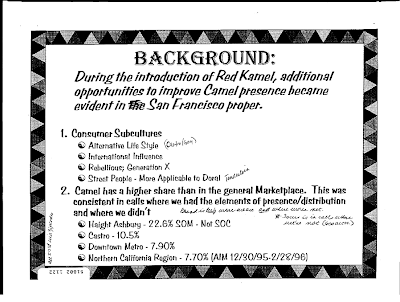
In essence, these companies could be held responsible for the deaths of millions of people, yet somehow they manage to walk the streets freely. One of the best examples of specific groups being targeted was mentioned in Courtney Trouble’s article, “Where There’s Smoke…” there was mention of the controversial mid-nineties project S.C.U.M. (Trouble 2005) In case you were wondering, SCUM was an acronym for Subculture Urban Marketing. This marketing campaign was created in the early nineties by R.J. Reynolds Company to target lesbians/gays living in the Castro and homeless people living in the Tenderloin, both neighborhoods in San Francisco. As if members of the LGBT community did not have it hard enough already, they soon found out what patriarchy really thought of them.
Let’s break this down. In order for “someone” to be found guilty of first degree murder, the government must prove that the person killed another person. According to the American Cancer Society, “438,000 people die from illnesses related to cigarette smoking.” (American Cancer Society 2007) Well, there is your proof that somebody actually died.
Next, we must prove that “the person killed the other person with malice or forethought.” The documents for Project S.C.U.M. included some lovely handwritten notes. (as pictured above) “Consumer Subcultures --Alternative Life Style (handwritten: "Castro/gay") --International influence --Rebellious; Generation X --Street People...more applicable to Doral (handwritten: "Tenderloin" (tobaccodocuments.org) The scribbled comments do not seem like terms of endearment and they clearly put some forethought into this plan, hence the premeditation.
“To kill with malice aforethought means to kill either deliberately and intentionally or recklessly with extreme disregard for human life.” (Cal. Penal Code S 189) I could go off on a limb and say that the companies did this intentionally and deliberately but they would just counter by saying that they didn’t. However, the “recklessly with extreme disregard for human life” portion fits them to a tee. (Cal. Penal Code S 189) These corporations do not care about the people. In fact, the whole point of the S.C.U.M. proposal was to get more people to use cigarettes. Going further I could prove that this act has been premeditated since the R.J. Reynolds company was started back in 1875. Either way, this corporation is responsible for millions of deaths, but because of our love of money, they get off scott free.

Here is my case:
Defendant: R.J. Reynolds Company

Victims: The 438,000 people who die each year from smoking related illnesses

Motive: Money/Greed

Kill with Malice aforethought: Intentionally & recklessly with extreme disregard for human life

Premeditation: Yes
All of the Above= Murder in the first degree
Links:
American Cancer Society: http://www.blogger.com/www.cancer.org/docroot/PED/content/PED_10_2X_Cigarette_Smoking.asp Project S.C.U.M. Documents: http://tobaccodocuments.org/landman/518021121.html
California Penal Code: http://www.lectlaw.com/def2/m053.htm
Trouble, Courtney. "Where There's Smoke...Tobacco Companies Have Used Some Icky Tactics..." Girlfriends. 26 Dec 2005
https://carmen.osu.edu/d2l/orgTools/ouHome/ouHome.asp?d2l_stateGroups=grid~gridpagenum~mycoursesstategroup&d2l_stateScopes=OrgUnitSession~GridPageNum~Search~PageNum%5EOrgUnitUser~LCS~MyCoursesStateGroup%5EUser~Grid~PageSize~HtmlEditor~HPG&d2l_statePageId=308579&d2l_state_grid=mcg12932~0~~Asc~~0&d2l_state_gridpagenum=mcg12932_pgN~0&d2l_state_mycoursesstategroup=mcg12932_tree~302123%2C302122%2C122310%2C175887%2C213536%2C213537%2C300435%2C300436%2C300437%2C300438&ou=993827

Digital Scrapbook #9: The Size 0 Debate & the Media


Add Image

Zero, zilch, nil, none… all of these words are synonymous yet if it is “nothing” then how can it be a size of clothing. I am slightly at odds when it comes to the size zero argument. It is not that I am not acknowledging that people of this size do not exist but I just don’t understand the point of it. It is just a number, why not make it a size 1 and push back the sizing chart one tier. Creating a size zero just, brings about another goal for women to aspire to.
If you leave the confines of the United States, you will find that there is no such thing as a size zero. In England our size zero is equivalent to a size 4. In the remainder of Europe it equates to a size 32. Either way, every conversion table gives a different number, but at least it isn’t zero.
Most perplexing however, are the conflicting views of the media. They criticize the fact that such a size was even created and but simultaneously perpetuate the thin beauty ideal. One moment a celebrity is too fat, (most likely normal sized) and the next moment they are too skinny. Basically the media contradicts themselves on what they deem as healthy, which is a terrible message for an adolescent society that takes the media as fact. I am greatly annoyed with many other issues revolving around the size zero debate but there is on that I think is incredibly important, Anorexia.
Each year we follow fashion week to see the trends of next season. Even though Madrid, took a stand a few years back and banned models with a Body Mass Index of under 18 and requested that they are medically certified as being so, anorexia and size 0 is still an issue. The most drastic response comes from Nolita, a fashion label which exhibited an advertisement featuring a nude anorexic woman. The advertisements have been posted during fashion week all of Milan.
Isabelle Caro is the “model” used in this advertisement. She is a an anorexic who has lived with the disease for over fifteen years. Isabelle spoke of her reasons partake in the campaign by saying, “I’ve hidden myself and covered myself for too long. Now I want to show myself fearlessly, even though I know my body arouses repugnance. I want to recover because I love life and the riches of the universe. I want to show young people how dangerous this illness is.” One can only respect the fact that she is using her illness to prevent others from doing what she has done. The photographer who shot the ad, Oliviero Toscani said his goal was “to use the naked body to show everyone the reality of this illness, caused in most cases by the stereotypes imposed by the world of fashion.” (DailyMail.co.uk)
It was successful at eliciting shock and displaying the reality of what anorexia does to bodies, but it failed. It only created what pro-ana sites like to call “thinspirational” photos. Women looked at some of Isabelle’s pictures and just loved how all 68lbs of Isabelle was fat free. Some of them looked at her like the Gisele of anorexic people.
It is that same effect that bothers me about size zero. Size zero is just another goal for women to set for themselves. Adding another size just makes women seek control, because maybe their pant sizes aren’t growing. Maybe the size charts are just changing.
At the same time I also question the motives of this ad. People already living with anorexia are accustomed to the distorted images in their head, so looking at a picture of another anorexic may not be that shocking. If this company wanted to help people suffering with the disease then they would have to do more than cover a town in posters. Do not forget though, that even though they are bringing a problem to light, it seems more of a ploy to get their brand noticed. I mean, who has heard of Nolita anyway? If they really wanted to take a stand and make a statement, then they would use “real” women in their fashion shoots.
Links:
"Fashion Company's Shock Tactics in the Fight Against Size Zero": http://www.dailymail.co.uk/news/article-483762/Fashion-companys-shock-tactics-fight-size-zero.html

Digital Scrapbook #10: Family Roles In Addiction


Family and Addiction go hand in hand as a codependent unit. Even though we are quick to point out that once person has a problem, every member plays a role that in some way affects the behaviors of the addict. These roles are often inadvertently accepted and unless they are realized will hinder an addict from recovering. Rehabilitation can help to a certain extent, but without participation from all of the people who frequently surround the troubled individual then a resolution is unlikely. This particular article on Hopelinks.net, attributes codependency as family/friends making decisions or taking on roles that make the addiction of a particular person possible. It suggests that there are six roles that an addict and its surrounding social group belong to. It lists the roles as the Addict, The Hero, The Mascot, The Lost Child, The Scapegoat, and The Caretaker (enabler).


*The Addict: The person with the addiction is the center, and though the key to alcohol and drug addiction recovery, not necessarily the most important in family recovery. The "world" revolves around this person, causing the addict to become the center of attention. As the roles are defined, the others unconsciously take on the rest of the roles to complete the balance after the problem has been introduced.
*The Hero: The Hero is the one who needs to make the family, and role players, look good. They ignore the problem and present things in a positive manner as if the roles within the family did not exist. The Hero is the perfectionist. If they overcome this role they can play an important part in the addiction recovery process. The underlying feelings are fear, guilt, and shame.
*The Mascot: The Mascot's role is that of the jester. They will often make inappropriate jokes about the those involved. Though they do bring humor to the family roles, it is often harmful humor, and they sometimes hinder addiction recovery. The underlying feelings are embarrassment, shame, and anger.
*The Lost Child: The Lost Child is the silent, "out of the way" family member, and will never mention alcohol or recovery. They are quiet and reserved, careful to not make problems. The Lost Child gives up self needs and makes efforts to avoid any conversation regarding the underlying roles.The underlying feelings are guilt, loneliness, neglect, and anger.
*The Scapegoat: The Scapegoat often acts out in front of others. They will rebel, make noise, and divert attention from the person who is addicted and their need for help in addiction recovery. The Scapegoat covers or draws attention away from the real problem. The underlying feelings are shame, guilt, and empty.
The Caretaker (Enabler):The Caretaker makes all the other roles possible. They try to keep everyone happy and the family in balance, void of the issue. They make excuses for all behaviors and actions, and never mention addiction recovery or getting help. The Caretaker (Enabler) presents a situation without problems to the public.The underlying feelings are inadequacy, fear, and helplessness (Hopelinks.net)


An excellent example of this dynamic is the Showtime series Dexter. A brief synopsis of the show is that Dexter Morgan, an introverted thirty-something lives a double life. By day he is a blood spatter expert for the Miami Police Department, all other times he is a brother, boyfriend, and serial killer. Dexter is not your average murderer thought, he is a vigilante who eradicates criminals that “slip through the cracks” of the justice system.


*Addict: Dexter Morgan, the series’ namesake is obviously the central focus of his world. As stated above, since he has the role of addict, the other characters take up roles to balance him out as we find learn of his need to kill.
*Hero/Mascot: Deb Morgan is Dexter’s non-biological sister and fellow police officer. Deb is a perfectionist who will do anything that will make her stand out on a predominantly male force. She always felt that her deceased father loved Dexter more, evoking a desire for closer relationship with her sibling. Dexter’s secret prevents that closeness but he comments she is as close to loving a person as he can come. Deb pretends that there are not problems and jokes that the killer could be a cop. Deb’s devotion to her only known relative blinds her to the fact that Dexter has a dark secret/problem.
*Lost Child: Rita, is Dexter’s on-and-off again girlfriend. The ex-wife of an addict and mother of two children, Rita is damaged. She ignores the fact that Dexter works weird hours and has abnormal tendencies in return for protection. In return for protection, Rita ignores what she suspects is a drug problem by keeping her mouth shut. She never insinuates that Dexter may have a problem, but appreciates the fact that he plays a fatherly role to her children.
*Scapegoat: Rudy and Lila are the scapegoats in Dexter’s World. Unbeknownst to Dexter, he had a brother, which like him was found a the scene of a drug deal massacre and shared a thirst for blood. Known as the “Ice Truck Killer,” Rudy stole the spotlight and took the fall for the murders even though his murders were not for the sake of justice. His motivations were an emptiness coming arising from the fact that Dexter’s was by a cop and he was left for the foster care system and the guilt of not being able to protect his mother. Lila, Dexter’s temporary fling was a fellow addict and sociopath. She recognizes Dexter’s weaknesses immediately in turn feeding her own addiction. Lila has an emptiness which she believes only Dexter can fill. Dexter returns to Rita which results in Lila stealing the spotlight. She sets her own apartment on fire, steals his girlfriends children, tries to get Dexter caught, and even sleeps with his best friend so she get all of the attention.
*Caretaker: Every person that surrounds Dexter is an enabler. Each character that he is “close” to knows there is a secret, but not the extent of it. They may ask questions but never follow through. His deceased father Harry was the primary enabler. Harry Morgan, also a police officer, sensed this addiction growing and instead of seeking help, he taught Dexter kill small animals and follow a set of noble rules.
All of these characters allow Dexter to carry out his need to kill. In order for Dexter to recover as the Hopelink website explains, each member will have to realize these roles and relinquish them. The members must find themselves whole as an individual and be there to support the addict. Since they are a codependent unit, they need to realize that their previous behaviors were allowing the addiction to exist. Unfortunately for Dexter, he has a long way to go.

links: Dexter Homepage- http://www.sho.com/site/dexter/home.do

Family Roles In Addiction & Codependency: http://www.hopelinks.net/addiction/family/roles.html

Wednesday, August 6, 2008

THIN

Leaving class was the most awkward time I have had this quarter. The elevator was silent, and a normally chatty bunch was left silent. I had previously watched this documentary before, however, this time was different. The first time I was alone at my house, in contrast to in a classroom. Watching people tear up and shudder made it more powerful. It is not the vomiting, feeding tubes, starvation, or skinny bodies that is shocking. The part that really affects viewers is the fact that stars are real people, just like you and me. They are mothers, sisters, daughters, nurses, college graduates, and any other role you can identify with. It is one thing to read an article about the effects of an eating disorder or watch a lifetime movie, but to watch people slowly kill themselves should be difficult for anyone to observe. I’m not going to lie there were parts and people in this film that made me want to scream and also parts that made me want to help people with eating disorders.
Brittany was the character I liked the least. Granted, she was only fifteen when this was filmed, but I have never wanted to smack somebody more in my life. This girl was given the opportunity to help herself, and throughout the film she kept saying how she wanted to try. Yet, at the end, during her meltdown in group, Brittany says she was forced to be there and that she doesn’t want help, she just wants to be thin. I felt like she had just wasted a lot of time and money lying not only to herself but also the people around her. Personally, I think Brittany just wanted the attention, not the actual weight loss. She was so consumed with the pity that people feel for her what I noticed with her was a theme of no love. She felt unloved when her mom didn’t answer the phone on the first call, she wrote “no love” on her art sculpture, and she even said it multiple times throughout the film. This girl clearly has issues, but I believe they lie much deeper than the self-imposed restrictions on her eating. Brittany was set up for failure, and she kept perpetuating that idea. Brittany’s mother has eating issues. As soon as I heard about her chewing and spitting game and how “fun” it was, I was appalled. It is no wonder the girl is so screwed up, her mother sends her mixed messages. She wants Brittany to get better, but at the same time she wants to be smaller than her daughter and not lose her enabling partner. I also wonder what else is going on in the life of that young girl, because her father is not even mentioned. I pity Brittany, but I am bothered by the fact that she always makes excuses and runs away unlike the other girls at Renfew.
Polly was the character that surprised me most. I thought she was the woman who was most likely to make a full recovery. She was so strong minded and seemed like a fighter, which is why it made me sad to read that she had committed suicide. Alisa and Shelly didn’t do much for me. Yes, both their stories were heartbreaking, but neither of them really wanted to get better. They both said one thing and did another. Shelly should not be a nurse, especially in a psychiatric hospital, she should almost be a patient there and the fact that Alisa is in charge of two children also scares me.
I liked this film a lot though because it’s real. There is no filter, there is swearing, puking, vulnerability, and hope. Hope that young girls can watch this and see that eating disorders are not cool, and that they should not be glamorized in the media. I appreciate the fact that these women were so gracious in allowing us to observe them, and I can only hope they are all better, even little Brittany.

Saturday, August 2, 2008

REPOST: JILL

Something is going on with either blogger, cut & paste, or microsoft word..if this doesn't work I can just e-mail it to you..

Listening to Jill speak was intense. All of our eyes were on her. It was so hard to believe that this individual could have a problem like an eating disorder. She is intelligent, thin, pretty, funny, and charismatic. There was only one disturbing part… each of us could find a part of ourselves in Jill’s story. Whether it be a bad experience at the pediatrician or emotional eating, we all can empathize with what she went through.
I found a lot of aspects of my life where I could identify with Jill. She spoke of her Irish dancing and it's toll on her body. My sport of choice was swimming. Swimmers are not supposed to be fat people, so I fit in there. I was aware that kids pointed at the fat kids, and “ooooed” at the big splashes they made. (which I’m sure were about the same as everyone else’s) However, I suffered from hypothermic episodes because of my low body fat and was forced to take special drinks during practice to keep me from losing weight. You could see every muscle, every vein under my freckled skin. I soon learned that I might as well have been the fat kid because I was a freak too.
Most people don’t see thinness as a problem, but it is. Instead of growing wider I grew taller. By 3rd grade I was 48 inches….and 48 pounds. I was embarrassed by my “skinniness.” Kids called me string bean, bean pole, gangly, monkey, and adults stared at me like I should have been on a Christian Children’s Fund Commercial with Amazing Grace playing in the background. This was also when biker shorts and crotch-snap body suits were the trendy, and I couldn’t fit in. My biker shorts looked like basketball shorts, and because I was so long body I had to go up in size, which made my body suits look like a tucked in t-shirt.
Clothing remained an issue, in 7th grade, I was 5’7” with double D breasts and I wore a size 14 Limited Too kids pant. I remember my best friend got her first pair of L.E.I. jeans and their were size 7. I tried them on every time I went to her house but they never fit. The smallest junior size was a 1 at this point and I would swim in them. So I had to settle for capri pants before they were even popular because any kids pants were too short for me. For most of the year I wore shorts or long skirts my grandma would alter for me, because this was before there were long lengths in jeans. In college finally filled out a little, but thankfully there are many more options for me today.
The hardest part of my appearance was my Mom. She is 4'11" and plump partly because of a childhood growth problem. We look nothing alike, and people would ask her if I was adopted, if my dad was previously married, or if I was one of her nieces. When they would find out I hers, reactions ranged from gasps to odd looks. Each time a piece of her crumbled, but she never said a word. All I wanted to do was look like I belonged to my family.
I found myself in Jill’s story because her insecurities were the sources of her problems. Her doctor told her she was chubby, and mine showed me a box chart that explained that I was “Oddly” skinny. Telling a child she is odd in any aspect of life, especially at 8 will certainly have repercussions. Like Jill I won’t use a scale because I don’t want to know if I have fluctuated, plus I don’t need a scale, if my pants fit then I’m the right size.
She also mentioned about her emotional NOT-eating. I’m exactly the same way. My parents and friends can always tell when something is not right because I basically deflate. It’s not intentional; it’s just that my sadness, anxiety, anger, fear, whatever it may be consumes any ounce of hunger. I don’t consider it an eating disorder because I’m not doing it to lose weight, for control, or with any ulterior motive. It’s never for more than a few days anyway.
What was inspirational was the fact that she overcame her problem and turned it into something useful. I respect her for using her experiences to help others and inform people that you don’t have to be crazy to have an eating disorder. I may have not been the fat kid, but I was the skinny kid either way you aren’t normal.

Friday, August 1, 2008

Jill

Listening to Jill speak
was intense. All of our eyes were on her. It was so hard to believe that this individual could have

a problem like an eating disorder. She is intelligent, thin, pretty, funny, and charismatic. There was only one disturbing part… each of us could find a
part
of ourselves in Jill’s sto
ry. Whether it be a bad experience at the pediatrician or emotional eating, we all can empathize with what she
went through.
I found a lot of aspects of my life where I could identify with Jill. I was a competitive swimmer since age four. Swimmers are not suppos
ed to be fat people. I din’t necessarily limit my calories at age
four, but I was definitely aware of my body.

Friday, July 25, 2008

Quote/Shannon

“Judges such as the one who convicted Jennifer Johnson are pronouncing not so much “I care about your baby” as “You don’t deserve to be a mother.” (Roberts 10)
This quote from “Punishing Drug Addicts With Babies” is incredibly powerful and very true. As a society we are more likely take a negative approach to every situation. Most people forget that they are trying to improve their lives and others. An example is when we kill dandelions. Are you killing the dandelion because you are trying to help the grass from being killed by it, or is it because you just don’t like it? Weeds are plants too, like grass, but because they aren’t like everyone else we kill them instead of planting them somewhere else.
This is much like pregnant women who use drugs. They are different because they abuse a substance but instead of “planting them somewhere else” and helping them. We basically sentence them or their babies to death.
This death might not be immediate. It will most likely be a long and hard path. One that we think is changeable by simply separating a baby from and addict mother. It is a lot easier to direct a statement at something that you can see, feel, touch, and hear, like the mother. An unborn baby is inside and covered by this mother, so it’s much easier to accept the idea that this baby is not human. Even though that baby is a tiny human, we can’t see it, we can’t touch it, but we know its there… Babies cannot control who their parents are and the womb they will develop in, so it is that point the judicial system needs to consider. It’s a difficult situation. Do you consider the mother and baby as one unit or as separate units? I mean if you sit down and think about it, a mother and child regardless of the situation are always going to be connected.
I have also thought a great deal about Shannon’s statement of treating couples together. On paper this sounds like a wonderful solution, but the actual execution of it is more difficult. The relationships of these couples are not always the most stable. I have a friend who was in a drug relationship. I don’t think her partner even had to do anything, the drug courted her and soon she was head over heels. If drugs are the only component of a relationship getting even one member of the pair to partake in treatment is difficult, alone both of them. I even question whether there is love in these relationships or whether it is just enabling. Another issue comes in the fact that if one side falls they both go down. An alternative situation, which involves one user and one non user is just as difficult. In most cases, unless you have been a user or have been surrounded by one, you will never fully understand what the other person is going through. I would love to think that people are willing to help the people they love out, but sometimes the substance is more powerful than any feeling.
Personally, I think that a person should seek individual treatment followed by couple’s treatment. I think it is more beneficial for a person to “find” themselves and then see how the new “them” interacts with their partner. As good of a support a partner is, they are also the worst enemy for an addict.

Wednesday, July 16, 2008

Guided Blog #4

After reading, seeing, and discussing parenting seems so hard. There is not a correct formula for parenting and teaching your offspring about the harsh realities of life. We can look at Koren, an upper-middle class white girl, with all of the tools and resources to succeed, yet she abused alcohol. Her parents were married and seemed to have a good relationship. They spoke to her about drugs and other issues in a relaxed manner, but none the less they were there.
Then we have Jessica and Michelle. Like Koren, Jessica is a white female raised in a upper-middle class neighborhood with at least two parents. She has an incredibly loving mother who cares about her deeply. Michelle parents Jessica in an extremely relaxed style, which focus’ on being her friend more than a parent. It also can be observed that Jessica’s Step-father is not part of parenting her.
Finally, there is Afeni Shakur. A single, black mother addicted to drugs, active in political groups, and extremely impoverished. She was incredibly straightforward with Tupac and her daughter, but wasn’t always around. Afeni was also in jail a great deal as well.
Oddly enough, I almost think that Tupac had the best upbringing. He may have not had money or a stable parent. However, this absence taught him to fend for himself and to be creative. When Afeni was present in his life, she was not afraid to say no and inform him of the repercussions of his actions.
It almost doesn’t matter if you have two parents and a lot of money, because unless your parents teach you about life, through either experience or discussion, a child will not learn. Even if they teach themselves, the manner in which they do may not be correct. Koren and Jessica both had parents, but the fact that Koren’s set were oblivious to her behavior and Jessica’s mom was more concerned with friendship than parenting are equivalent to them not even being there. In essence, Koren and Jessica were parentless for majority of their lives. Nobody taught those girls about alcohol and its evils. Nobody told them about drugs and sex. Most importantly people rarely said no or intervened. The fact that Jessica admits to blacking out four times a week to her mother is disgusting. Michelle appears somewhat bothered, but is more concerned with her 30 day binge drinking experiment. Koren’s mother does something similar but saying, you can drink but only with us.(too bad it was already too late to impose that rule)
This is not to say that Afeni Shakur deserves any parent of the year awards. She was a drug addict and a Black Panther, but she never forgot her children. She made many mistakes but she was there to say No and teach her kids about life on the streets. She worked hard to be both parents and keep a roof over her family’s head in a time when her race, gender, political views, social status, relationship status, and use of drugs oppressed her.
In the end I was more upset with the fact that Jessica and Koren were extremely privileged and used all of their resources in a destructive manner. More importantly, those girls didn’t even appreciate their parents. In fact, Koren seemed more bothered by their presence than anything. Tupac definitely made some mistakes but he rose above the obstacles and oppressions by educating himself and appreciating the woman who gave him life. There is no proper way to rear a child and mistakes are inevitable, but it is better to make mistakes than live in fear of making them and not doing anything at all.

Friday, July 11, 2008

A letter to Koren

Dear Koren,
In one of my favorite movies, A Bronx Tale, they say, “the saddest thing in life is a wasted talent.” Well you were a waste. You can write a book of excuses as to why you did what you did, but in the end they are only just excuses. Not once did you take any accountability for your actions and that to me is bothersome. When you woke up next to a random guy because you were drunk the previous night, why didn’t that put you in check? The first step to fixing yourself is admitting you have a problem. You are an alcoholic. You are way beyond just an abuser. I know abusers and binge drinkers, and they cannot even begin to hold a candle to you. But, you may define your issues as you wish.
When I read your book, I started off with sympathy for you. I tried so hard to emphasize with someone in your position, but I just couldn’t. You had everything in front of you, all the tools for success. Were you trying to rebel? Were you spiteful of your parents or just an angry teen? It is so difficult for me to imagine how your life came to be this way. Your descriptions of alcohol and the way it makes you feel is so disturbing. You are a girl that had everything in life, beauty, brains, and a good family. All of those factors could have led to an happy life doing whatever you pleased. But you ruined it…
However, you did eventually make a change and I do applaud you for that. I respect the courage it took to write this book and admit all the shameful acts you committed as a youth. There is one aspect of this whole production that does perturb me. You say that you wrote this book to inform young girls about drinking, alcohol abuse, and the college experience, which motivations to help. That being said, Do you think it’s right that you profit from your deviant behaviors. If you really wanted to help others in your position then you could use the proceeds to build a hospital specifically for young girls facing the same issues you had. It almost seems as if you wrote this book for shock value and to better your future career as a novelist.
I went on your website to see if I was wrong about you, and this is what I found:

What are your plans for the immediate future?
I'd like to keep on writing, reading, paying rent, paying taxes, paying my debt to society. Likewise, I hope to keep traveling, keep pissing people off, keep doing things I'll live to regret.(korenzalickas.com)

Then I learned that you have even sold the rights of the book to a production company. If anything, make sure that this movie is done properly, and that the underlying message of your book is not lost. Unfortunately, I don’t feel that I wrong about you. I don’t believe you have learned. Pissing people off and doing things you’ll live to forget? Didn’t you do enough of that already Koren?? At some point you have to grow up…
There is one thing I wondered about and that is your sister. What did your lifestyle do you her? When she was younger, she was not privileged to your deviance, but she had to figure it out. I hope that she didn’t follow your path, and I can only hope that someday you raise a daughter of your own and teach her not to make the same mistakes you made. I wish you the best in life, but I don’t ever want to meet you.